
Insulated sectional garage doors
An insulated sectional garage door is built from horizontal steel panels with a foam core bonded between two skins, usually 40 to 42 mm thick, or around 67 mm on thermally broken doors. The panels hinge as they rise, run up vertical tracks and park flat under the ceiling, so the door keeps heat in, cuts noise and never swings out onto the drive.
- Panel thickness: Typically 40 to 42 mm double-skin, or thicker thermally broken panels on premium ranges.
- Seals all round: Bottom, side and head seals, plus gaskets between sections.
- Electric or manual: Most insulated doors are motorised; manual operation is possible on lighter doors.
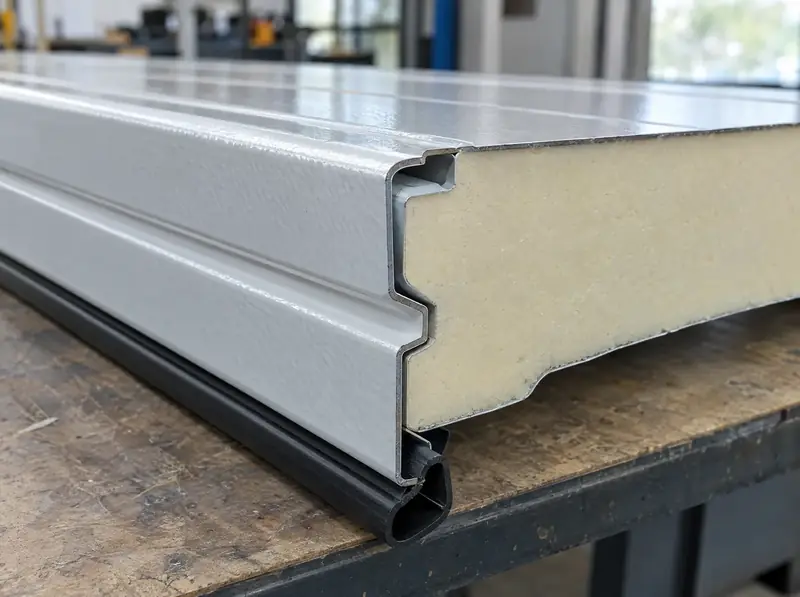
Why choose a foam-filled panel over single-skin steel?
A single-skin door is a sheet of steel and little else, so the garage runs at outdoor temperature. A double-skin panel with a polyurethane core slows heat loss, stops the panel drumming in wind and gives a stiffer, quieter door. If the garage is a workshop, gym, utility or store for anything that dislikes damp and cold, insulation is the part of the specification that earns its keep.
What thickness should you pick?
Most domestic sectional doors use panels of about 40 to 42 mm. Doors sold as thermally broken use thicker panels, often around 67 mm, with a break between the inner and outer skins so cold is not conducted straight through. The thicker option costs more and needs a little more headroom, so it makes most sense on integral or heated garages.
How much difference do seals make?
Panels are only half the story. A good door has a flexible bottom seal that follows uneven floors, brush or rubber side seals, a head seal and finger-safe joints with gaskets between sections. A badly sealed insulated door can lose more heat round the edges than through the panels, so seals are checked and set on fitting day.
Will an insulated door help an integral garage?
Where a garage shares walls with the house, a colder garage means colder shared walls and rooms above. An insulated door will not turn a garage into a habitable room, but it does take the edge off, especially paired with a draught-sealed door between the house and the garage.
Is it worth it on a detached garage?
On a detached garage used only for a car, a standard double-skin door is usually enough. If you keep tools, bikes, a freezer or stock in there, or you use it as a workspace, the warmer, drier conditions are worth the extra cost.
Do insulated doors weigh more?
Yes. Foam-filled steel panels are heavier than single-skin doors, which is why every sectional door is balanced by springs sized to that door, either torsion springs on a shaft above the opening or tension springs along the tracks, depending on the range and size. They are set during fitting so the door feels light by hand and the motor is not straining.
How long do the panels last?
Galvanised and factory-coated steel panels are made for many years of outdoor use. Look after the coating with an occasional wash, keep the bottom seal clear of grit and leaves, and book a service every year or so to keep springs and cables in order.
What options are there?
- Panel thicknessTypically 40 to 42 mm double-skin, or thicker thermally broken panels on premium ranges.
- Seals all roundBottom, side and head seals, plus gaskets between sections.
- Electric or manualMost insulated doors are motorised; manual operation is possible on lighter doors.
- Any finishRibbed, flush, cassette, woodgrain and coloured finishes are all available with insulated panels.
- Window insertsAdd glazed inserts for daylight; they slightly reduce thermal performance.
Key facts
| Panel construction | Two steel skins with a polyurethane foam core |
|---|---|
| Typical panel thickness | 40–42 mm (thermally broken around 67 mm) |
| Operation | Torsion or tension springs; electric or manual |
| Opening | Vertical, parks under the ceiling |
| Lead time | Made to measure; typically a few weeks |
| Guide price | £2,095–£3,495 inc VAT |
Who is it for?
Best suited to integral garages, workshops, home gyms and garages that share a wall with the house.
Do I need permission?
Replacing a garage door does not normally need planning permission anywhere in the UK. The usual exceptions are listed buildings, conservation areas, Article 4 areas in England and newer estates where planning conditions restrict changes to garages. Planning rules by nation →
Questions people ask
How much does an insulated sectional garage door cost?
Guide prices for a single insulated sectional door supplied and fitted with an electric operator run £2,095–£3,495, from a standard door up to thermally broken panels. Size, finish, glazing and the state of the opening all move the figure, so we confirm a fixed price after a free survey.
Is an insulated garage door worth it?
If the garage is integral, heated, used as a workspace or stores anything sensitive to cold and damp, yes. For a detached garage used only for parking, a standard double-skin door is often enough.
What U-value will I get?
Manufacturers publish U-values for each range and size. As an example, one leading range quotes about 1.4 W/m²K for a fitted 42 mm door and about 1.0 W/m²K for its 67 mm thermally broken version, against roughly 6.5 W/m²K for a single-skin steel door of the same size. Window inserts reduce performance slightly. We give you the published figure for the exact door on your quote.
Can an insulated door be fitted to an older garage?
Usually, yes. The opening needs to be sound and square enough to fix to, with enough headroom above the opening and room either side for the tracks. The survey checks all three.
Do insulated doors need more headroom?
Thicker panels can need slightly more headroom. Where space is tight, a low-headroom track or a side-sectional door may suit better.
Can I add insulation to my existing up-and-over door?
Insulation kits exist for up-and-over doors, but they add weight that the springs were not designed for and seldom seal well. Replacing with an insulated sectional door is the reliable route.
You might also need


Insulated sectional garage doors near you
Choose your area for local details, nearby towns and planning contacts.
England
- Bedfordshire
- Berkshire
- Bristol
- Buckinghamshire
- Cambridgeshire
- Cheshire
- Cornwall
- County Durham
- Cumbria
- Derbyshire
- Devon
- Dorset
- East Riding of Yorkshire
- East Sussex
- Essex
- Gloucestershire
- Greater London
- Greater Manchester
- Hampshire
- Herefordshire
- Hertfordshire
- Isle of Wight
- Kent
- Lancashire
- Leicestershire
- Lincolnshire
- Merseyside
- Norfolk
- North Yorkshire
- Northamptonshire
- Northumberland
- Nottinghamshire
- Oxfordshire
- Rutland
- Shropshire
- Somerset
- South Yorkshire
- Staffordshire
- Suffolk
- Surrey
- Tyne and Wear
- Warwickshire
- West Midlands
- West Sussex
- West Yorkshire
- Wiltshire
- Worcestershire
Wales
Scotland
- Aberdeen and Aberdeenshire
- Angus and Dundee
- Ayrshire
- Dumfries and Galloway
- Edinburgh and the Lothians
- Fife
- Forth Valley
- Glasgow and Dunbartonshire
- Highlands and Islands
- Lanarkshire
- Moray
- Perth and Kinross
- Renfrewshire and Inverclyde
- Scottish Borders
Northern Ireland
Ready for your insulated sectional door?
Get a guide price in under a minute, then book a free survey for a fixed written price.